


How are workers' comp premiums calculated?
What is workers' comp insurance and why is important?
Workers' compensation insurance helps your business and your employees recover from workplace injuries and illnesses. This includes everything from a minor injury to a serious incident, such as a broken bone or concussion from a workplace fall.
While workers' comp laws differ by state, this policy is generally required as soon as a small business hires its first employee (or a certain number of employees), including both part-time and full-time employees.
Workers' compensation benefits will take care of your injured workers by paying for their medical expenses, including medications, physical therapy, and doctor visits. And if the employee sues, it’ll cover legal expenses as well.
If you don't purchase workers' compensation, you can find yourself paying out-of-pocket for costly medical bills and legal fees, which can financially devastate your small business. In addition, most states impose steep penalties for noncompliance.
A workers’ compensation policy will cover any reasonable and covered injury claim, regardless of who caused the accident or injury.
What factors affect workers’ comp insurance premiums?
Insurance companies calculate your workers' comp insurance costs through a few factors:
- The type of work you and your employees do (as reflected by their classification codes)
- Your claims history (which impacts your experience modification rating)
- Your payroll, which reflects how much your employees are being paid
Through these factors and more, your insurance provider will calculate your workers' compensation premium:
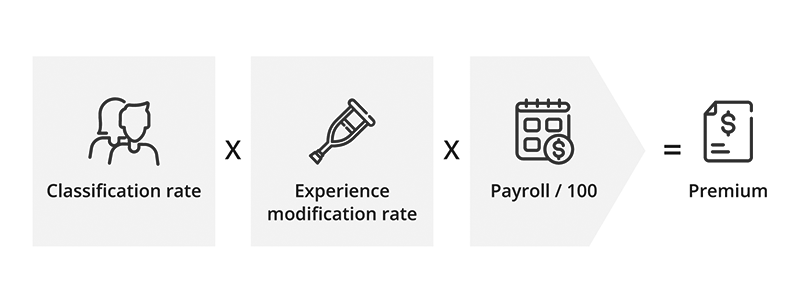
Your workers' comp classification rate (class code)
Most insurance companies and states use the National Council on Compensation Insurance (NCCI) class code system to determine your risk level and set workers' compensation insurance rates.
Some jobs carry a higher risk than others due to the work environment. And those who are more likely to be injured will contribute to higher workers' compensation coverage premiums.
For example, small business owners pay higher workers' comp premiums for employees in riskier roles, such as landscapers and carpenters, than for office workers, such as graphic designers.
Regardless of risk level, ensure all employees are covered by your workers' compensation policy.
Your experience modification rating (EMR or e-mod)
Your Experience Modification Rating (EMR) is a metric established by insurance agencies to determine and track a company's safety record and predict potential costly workers' comp claims. This number can positively or negatively affect your workers' compensation costs.
A lower EMR rating can lower your rates, while a higher EMR rating can increase your rates.
In some instances, an EMR rating that is too high can disqualify you from certain professional opportunities, such as construction projects.
Your payroll
The more your employees earn, the higher your workers’ compensation costs are likely to be.
Employees who suffer work-related injuries can collect partial weekly wages, so your insurance agency will factor your annual payroll costs into your workers' compensation premium calculation.
How does business location impact workers’ comp insurance rates?
Because workers’ compensation laws are set by each state, where your employees work will determine how much you pay for this policy.
Some states, like California, require employers to obtain workers' comp coverage after hiring their first employee. Other states, such as South Carolina, won't require workers' comp coverage until after the fourth employee. In Texas, coverage is optional but highly recommended.
North Dakota, Ohio, Washington, and Wyoming all require business owners to purchase workers' comp from a state fund. These are monopolistic states that offer small businesses only one option for getting workers' comp coverage. This means the premiums are well-established and there isn't as much flexibility on cost compared to other states.
Independent contractors and sole proprietors are often not required to carry workers' compensation, but should consider doing so anyway because of the costly risks of workplace injuries and the fact that personal insurance won't cover them.
What additional factors influence workers' comp net rates?
While your workers' comp class codes, EMR rating, and payroll are the main factors that determine your workers' comp rates, there are other factors that are considered as well. These factors include:
- State regulations: Your state and local laws can affect workers' comp rates, as they govern workers' comp regulations.
- Premium discounts: Higher premiums and larger policies can often come with sizable discounts.
- Audits: Insurance companies will occasionally perform audits and adjust policies based on actual payroll rather than projected payroll.
- Workplace safety programs: Enrolling your employees in regular training and safety programs can help lower your premium rates and prevent workers' compensation claims.
Individual insurance agencies have workers' comp calculators that are largely proprietary, however we can still estimate costs based on the above factors.
Find workers' comp requirements in your state

How to get affordable workers’ compensation insurance
Correctly classify employees and subcontractors
Establish safety measures
Consider cost-effective premium policies
You can save money through certain workers' comp payment structures and options:
- Pay-as-you-go workers' comp is a payment option that sets your insurance rates based on actual payroll rather than projected payroll. Projections often lead to higher rates, so a pay-as-you-go option is popular among small business owners who need to keep workers' compensation insurance premiums low.
- A workers' comp ghost policy is sometimes available if you need workers' comp to meet requirements or contract stipulations, but don't anticipate needing coverage. It's an important disclaimer that this can be a risky option as it does not provide any actual coverage and is not legal in all states.
- A minimum premium workers' compensation policy may be an option if you work in a lower-risk industry. To qualify for this policy, you would need to run a very small business and operate with minimal risk.
Find workers' compensation insurance for small businesses
TechInsurance is a trusted insurance expert for all small business owners. Fill out our application today to get free quotes and find the right policy for your business.
Our licensed insurance agents are available to answer your questions and help you find the coverage that's right for your business needs.
With TechInsurance, you can easily download a certificate of insurance for your small business, often on the same day you buy workers' compensation insurance coverage or other types of insurance products.
This comes in handy for companies that need proof of insurance to sign a contract or a lease and don’t have time to call an insurance company for documentation.
Clients may ask for a certificate of workers' compensation insurance or other types of business insurance to show you’re insured.
Verified workers' compensation insurance reviews
Hear from customers like you who purchased workers' compensation coverage.


