


Are business owners covered by workers’ compensation insurance?
What is workers' comp insurance and when is it required?
Workers' compensation insurance protects you and your employees in the event of a work-related injury or illness.
Most state workers' compensation laws require employers to carry this policy if they have a certain number of workers, often starting after the first employee is hired. This typically includes both full-time and part-time employees.
Workers' comp insurance covers medical costs, medication, doctors' visits, physical therapy, and other recovery services for work-related injuries. It also typically includes employer's liability insurance, which protects the business if an employee chooses to sue over their injuries.
Some industries, such as construction and other higher-risk professions, require all employees (including the business owner) to be covered by workers' compensation, regardless of state coverage requirements.
Find workers' comp requirements in your state

Do business owners need workers’ compensation coverage for themselves?
Business owners typically are not required to carry workers' compensation for themselves. While state laws often mandate that they carry coverage for their employees, the owner can choose not to add themselves to their workers' comp policy.
As the business owner, you can elect to submit an exemption or exclusion to forego your workers' compensation coverage if you do not wish to carry it for yourself.
That being said, you may find that some potential clients and business partners may refuse to work with you if you aren't covered because it can open both parties up to liability if you get injured.
Additionally, if you are injured on the job and don't have workers' comp, you would likely be held liable to pay for your injury, medical bills, lost wage replacement, and other out-of-pocket costs if you do not carry coverage for yourself. This could get very costly and potentially devastate your small business financially.
Can I use my own insurance instead of workers' comp?
Private health insurance policies will typically deny medical claims for work-related incidents. This is one of the main reasons that small business owners elect to purchase workers' comp for themselves.
For example, an IT consultant develops carpal tunnel due to the long hours of typing associated with the profession. They go to the doctor for a diagnosis and plan to attend physical therapy, but their private healthcare denies the claims, saying it's work-related.
A workers' compensation plan would have helped pay for medical care, rehabilitation, and even lost wages during time off for recovery.
Many self-employed individuals purchase workers' compensation insurance for themselves as financial protection and a safety net in the event of a work-related incident.

Are sole proprietors required to carry workers' comp?
Generally speaking, sole proprietors, independent contractors, and other self-employed individuals without employees or subcontractors do not need to carry workers' comp insurance coverage.
The main exception is for high-risk industries in certain states, such as general contractors and other construction professionals.
Single-person businesses are often vulnerable to the risks and costs associated with workplace injuries, as they don't have PTO, sick leave, and other employer-provided benefits. This makes workers' compensation an exceptionally valuable plan for self-employed business owners.
How much does workers' comp insurance cost for business owners?

Workers' compensation policyholders pay on average $54 per month, or $643 a year, for coverage. Your exact cost may be more or less, depending on your risks.
The cost of workers' compensation insurance is based on several factors, including:
- Number of employees
- Business location
- Claims history
- Policy limits and exclusions
- Payroll
- Industry and associated risk factors
- Risk management and safety programs implemented
How is my workers’ compensation premium calculated?
Insurance companies determine workers' comp insurance costs through a few factors, including:
- The type of work you and your employees do (as reflected by their classification codes)
- Your claims history, including workers' compensation claims
- Your payroll and how much your employees are being paid
Through these factors and more, your insurance provider will calculate your workers' compensation policy premium:
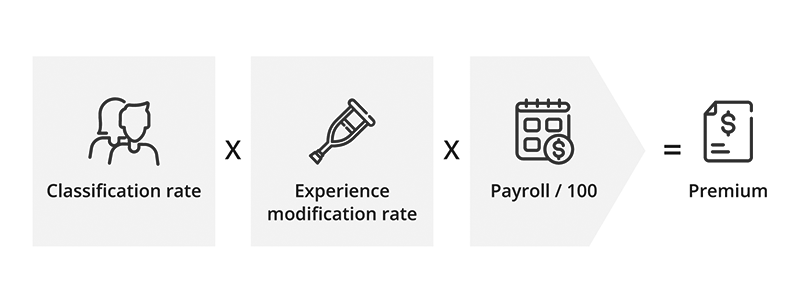
Your class codes, often based on the National Council on Compensation Insurance (NCCI) classification system, are established based on the type of work you do and the risks associated with that work.
Your experience modification rating (EMR) is determined by your claims history. The more claims you and your business have made in the past, the higher your EMR rating. It can also drop if time has elapsed since your previous claims.
Lastly, the more you pay in payroll, the higher your premiums will be.
These are three of the primary factors that help insurance companies calculate how much you'll pay for your policy.
How can I get affordable workers' comp insurance?
Small business insurance doesn't have to be expensive. You can save money on your workers' compensation policy in a number of key ways:
- Correctly classify employees and contractors. Verifying that you, your employees, and subcontractors are correctly classified can help ensure your business pays the right amount for coverage and avoids overpaying or underpaying.
- Establish safety measures. Good risk management protocols can prevent injured worker claims and the medical expenses that come with accidents and injuries for you or your employees.
- Consider cost-effective premium policies. You can sometimes take advantage of alternative payment structures, such as a pay-as-you-go workers' comp plan or a ghost policy, to potentially save on your business insurance costs.
Avoiding workplace injuries, practicing proper risk management, and keeping your claims to a minimum will help you save on your workers' comp coverage.
Find workers' compensation insurance for small businesses
TechInsurance is a trusted insurance expert for small business owners. Fill out our application today to get free quotes and find the right insurance policy for your business.
Our licensed insurance agents are available to answer your questions and help you find the coverage that's right for your business needs.
With TechInsurance, you can quickly download a certificate of insurance for your small business, often on the same day you buy workers' compensation insurance coverage or other types of insurance products.
This comes in handy for companies that need proof of insurance to sign a contract or a lease and don’t have time to call an insurance company for documentation.
Clients may ask for a certificate of workers' compensation insurance or other types of business insurance to show you’re insured.
Verified workers' compensation insurance reviews
Hear from customers like you who purchased workers' compensation coverage.


